
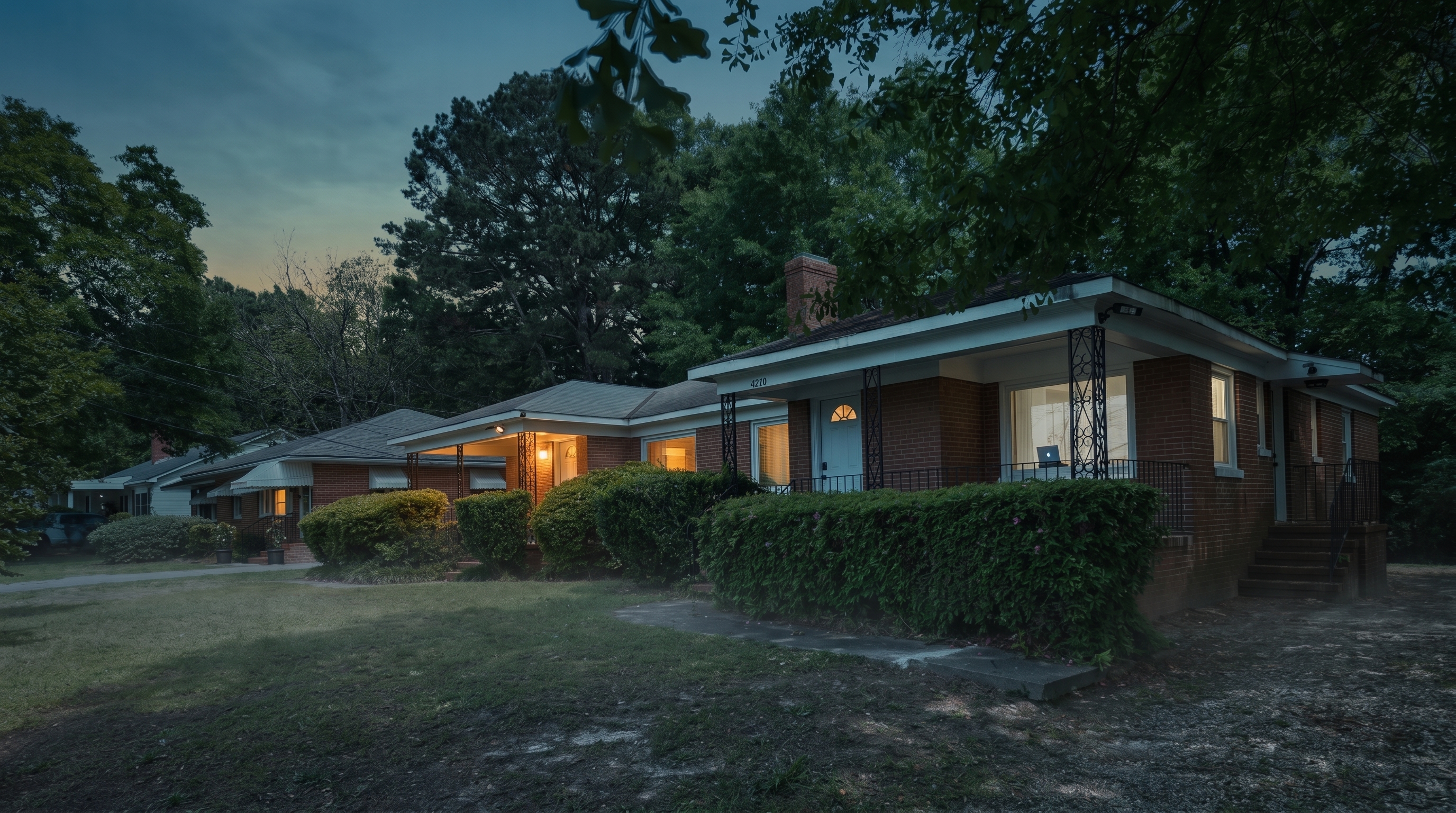
Columbus is a duplex town. Drive any block in Uptown, Lakebottom, or the Historic District and you'll count more 2-on-a-lot configurations than standalone single-family. For STR investors, that's an opportunity — two income streams under one roof, shared maintenance, shared utilities, shared access. On paper, it's the cleanest version of the Missing Middle thesis.
In practice, most Columbus duplex owners are leaving 20–30% of their potential STR revenue on the table because both sides of their building are silently cannibalizing each other in Airbnb search.
Here's the mechanic, and here's how to fix it.
The Duplicate-Content Penalty
Airbnb's search algorithm has a duplicate-content filter. The logic is straightforward: if two listings from the same host, at the same address, look interchangeable, surfacing both wastes a search-result slot that could go to a more diverse option. The platform's incentive is guest-side optionality, not host-side maximization.
The penalty isn't a ban. It's a silent down-ranking applied to both sibling listings. Your CTR drops on both sides. Your impressions drop on both sides. And because both listings are marketed by the same host, it's nearly impossible to diagnose without comparative analytics across the pair.
We see this pattern across nearly every duplex pair in our managed Columbus portfolio. The signature is unmistakable: one side of the building shows a CTR around 4% with an 85%+ inquiry-to-book conversion rate. That combination — low click-through, elite conversion — is not a listing-quality problem. A guest who clicks is sold. The problem is that not enough guests are clicking, because Airbnb is suppressing impressions.
How Self-Diagnosis Fails
Most owners run the wrong play when they see a sibling listing underperform. They assume it's a photo problem and reshoot the gallery. They assume it's a description problem and rewrite the copy. They drop the price. None of those moves address the actual cause, because the actual cause is similarity to the listing next door.
You can have professionally staged photos, A-grade copy, and competitive pricing on both sides of the duplex and still bleed visibility. Two well-executed listings that look like each other are worse than one well-executed listing standing alone.
Three Compounding Problems
Beyond the algorithmic penalty, duplex pairs marketed identically suffer from two other revenue leaks:
Guest confusion kills conversion. A traveler searching "2BR near St Francis Hospital" sees two of your listings with similar hero photos and similar descriptions. Their reaction isn't enthusiasm — it's hesitation. "Wait, are these the same place? Why are there two?" Hesitation creates click-through to a competitor with a clearer offer.
You split your own demand pool. If 10 monthly bookings exist in a submarket and you have two indistinguishable units competing for them, you don't capture 10. You capture 6 or 7, because confused traffic bounces. Your competitors absorb the bookings you should have won.
Operational risk compounds. Same-day double bookings on a duplex create shared-wall noise complaints, shared-parking capacity issues, and trash overflow — every one of which routes back to a sub-3-star review on the listing that draws the unhappier guest. The cleanliness penalty mechanic is well-documented: a single sub-3-star cleanliness review can suppress a Columbus listing for 60–90 days.
The Fix: Differentiated Positioning
The solution is structural, not cosmetic. Each side of the duplex needs to target a fundamentally different guest avatar — different price point, different amenity emphasis, different listing copy, different pet policy.
In our St Francis Hospital duplex pair, one unit is positioned for visiting families needing space and pet flexibility. The other is positioned for traveling medical professionals on 13-week contracts, with no pets, a dedicated workspace, and aggressive monthly stay discounts. Same building. Two completely different products. Zero overlap in search.
In our Fort Benning–adjacent duplex, one unit is the budget 1BR for solo service members and small visiting groups; the other is the family 2BR for graduation weekends. The 1BR/2BR distinction does most of the work, but the listing copy reinforces it explicitly — including a cross-reference in each description that routes the wrong guest to the right unit.
The counterintuitive move: each listing should mention its sister unit by name in the description as the alternative for different needs. Airbnb's algorithm rewards listings that signal "I understand the distinction between my products" because it reduces guest confusion, which reduces refunds, which is what the platform actually optimizes for.
If you own a duplex in Columbus and both sides are running similar pricing with similar copy, you're not running two listings. You're running one listing twice. Stop.
Request a duplex audit: leasing@5pre.com | 706.510.0255
