
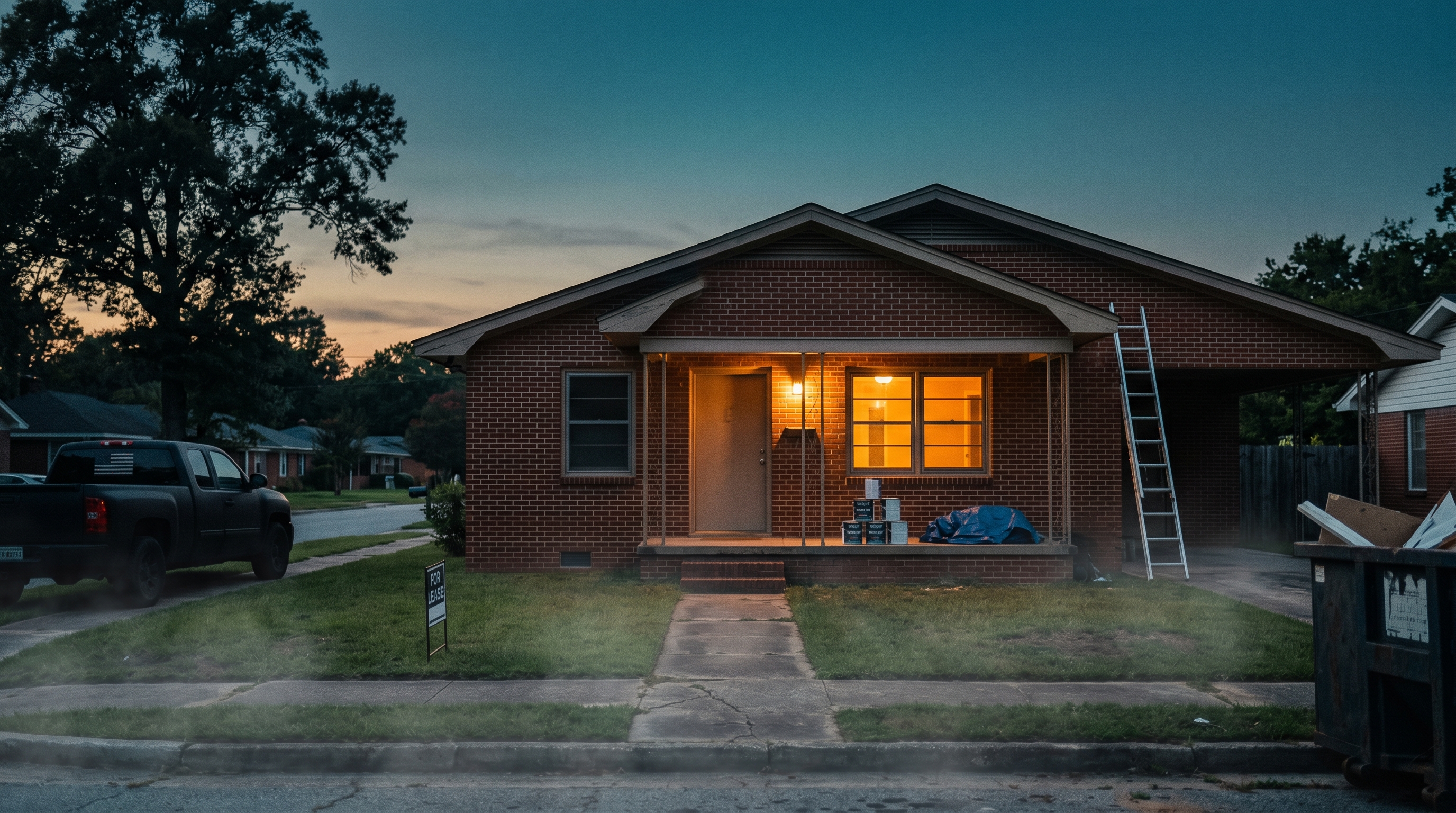
We get the same question every week from out-of-state investors looking at the Chattahoochee Valley: what's actually working in Columbus right now?
The answer is not theory. It is what penciled out in our underwriting last week and what didn't. Three strategies are putting points on the board in Columbus in 2026. Each one has a specific zip code, a specific math, and a specific way to lose money if you run it wrong. Here is the breakdown — confirmed against actual Zillow inventory and current market data.
The Market Backdrop
Before we get into the strategies, the numbers you need to anchor everything else:
- Columbus median single-family list price (Mar 2026): $195,000 / 101 days on market.
- Columbus median multi-family list price (Apr 2026): $151,000 / 134 days on market.
- Zip-level price spread: 31906 ($128K) / 31907 ($156K) / 31903 ($68K) at the bottom; 31909 ($229K) / 31904 ($206K) at the mid-tier; 31820 ($376K) / 31808 ($383K) at the top.
- HUD FY2026 Fair Market Rents — Columbus, GA-AL HMFA: 1BR $939 / 2BR $1,088 / 3BR $1,445 / 4BR $1,703.
- HACG Section 8 vouchers under management: 3,914. The waitlist is currently closed — meaning existing voucher holders are the only ones in the pipeline, and they are actively shopping for units that pass HQS inspection.
- DSCR cash-out refinance rates (May 2026): 6.0%–7.99% depending on credit, LTV, and DSCR ratio. 75% LTV is the standard ceiling for cash-out.
Those are the facts on the ground. Now the three strategies.
Strategy 1: BRRRR + Section 8 in 31906 / 31907 / 31903
Verdict: Works. The math is real. The risk is rehab overrun and Payment Standard surprises.
The thesis: buy a tired C-class single family in East Columbus, Midtown, or South Columbus for $50K–$70K. Spend $30K–$45K bringing it to HQS standards and adding a second bath where the floor plan allows. Refinance at 75% LTV against a $135K–$155K ARV. Lease to a Section 8 voucher holder at or near the FMR 3BR ceiling of $1,445. Recycle most or all of your capital and start over.
Live Zillow inventory anchoring this thesis
These are real listings as of this week:
- 869 Goodson Dr, Columbus, GA 31907 — $60,000 / 3BR/1BA / 952 sqft
- 21 Lafayette Dr, Columbus, GA 31903 (Benning Hills) — $55,000 / 4BR/2BA / 1,404 sqft, tenant-occupied
- 5526 Buena Vista Rd, Columbus, GA 31907 — $47,500 / 3BR/1BA / 1,293 sqft, brick fixer
- 2846 Walker St, Columbus, GA 31903 — $58,900 / 3BR/1BA / 990 sqft
These are not unicorns. They are sitting on the MLS right now. Sub-$70K product is plentiful in this market because the median in 31906 and 31903 is below $130K to begin with.
The math on a typical deal
Take the Goodson Drive listing as the anchor:
| Line Item | Amount |
|---|---|
| Acquisition | $60,000 |
| Closing + holding (3 months) | $5,000 |
| Rehab to HQS (paint, mechanicals, smoke detectors, second bath) | $35,000 |
| All-in basis | $100,000 |
| ARV (renovated 3BR/2BA comp range $135K–$150K) | $145,000 |
| Cash-out refi at 75% LTV | $108,750 |
| Capital recovered at refi | ~$103,000–$108,000 |
| Trapped equity | ~$0–$5,000 |
That is the BRRRR ideal: nearly all capital recycled. Now the operating side:
| Monthly Cash Flow | Amount |
|---|---|
| Section 8 rent at or near FMR 3BR | $1,445 |
| P&I on $108,750 at 6.5%, 30-year | ($687) |
| Property tax + insurance | ($200) |
| Property management (10%) | ($145) |
| Maintenance + CapEx reserve (10%) | ($145) |
| Vacancy reserve (Section 8 reduces this — 3%) | ($43) |
| Net cash flow | ~$225/month |
That is the realistic underwriting after a thorough reserve discipline. Aggressive operators with lower management costs net $350–$400. The cash-on-cash return on $5K of trapped equity becomes almost irrelevant — what matters is the perpetual capital recycling.
Where this strategy quietly kills investors
Three places.
One: the Payment Standard is not the FMR. HUD publishes the FMR. HACG sets the local Payment Standard, which can sit anywhere from 90% to 110% of FMR. If HACG's 3BR Payment Standard is $1,300 instead of $1,445, your underwriting just lost $145/month — half your cash flow. Always pull the current Payment Standard chart from HACG before locking pricing. Do not assume FMR equals what you will collect.
Two: rehab overrun on systems you cannot see. Pre-1970 brick ranches in 31906 and 31903 are notorious for cast iron drain stacks, knob-and-tube electrical fragments, and original HVAC ducts that fail HQS lead-paint and mechanical inspection. A $35K rehab budget is reasonable for a property in fair shape. A $35K budget on a property with a hidden sewer line collapse becomes $55K, and your refi proceeds no longer cover your basis.
Three: appraisal disappointments. The 75% LTV refi is calculated against the appraiser's number, not your wishful ARV. Pull three to five rented-comp sales within a half-mile in the last six months before you buy. If your ARV thesis depends on comps from outside the immediate neighborhood, the appraiser will not stretch for you.
The bottom line on Strategy 1: the math works, but only with disciplined acquisition pricing, conservative rehab budgeting, and pre-verified Payment Standards. This is the highest-volume play in Columbus right now. It is also the play where the biggest acquisition mistakes get made.
Strategy 2: C-Class Flips with Extended Hold Times
Verdict: Works for experienced operators. Margins are razor-thin. Most amateurs lose money here.
The thesis is similar to Strategy 1 on the buy side — same zip codes, same product, same acquisition price band — but the exit is a retail sale rather than a refi-and-hold. The pitch sounds attractive: same buy-box, faster capital cycle, no tenant headaches.
The math says otherwise.
Live Zillow inventory in the flip strike zone
- 3110 Morehouse St, Columbus, GA 31906 — $115,000 / 3BR/1BA / 1,023 sqft
- 2829 Hood St, Columbus, GA 31906 — $145,000 / 3BR/1BA / 1,053 sqft
- 4525 Sentry St, Columbus, GA 31907 — $165,000 / 3BR/1BA / 1,058 sqft
These are the cosmetic-rehab tier — already livable, not gut jobs.
The math on a typical deal
Take 3110 Morehouse St:
| Line Item | Amount |
|---|---|
| Acquisition | $115,000 |
| Rehab (cosmetic + add second bath) | $35,000 |
| All-in basis | $150,000 |
| Holding costs (6 months: insurance, utilities, taxes, hard money interest at 11%) | $9,000 |
| ARV (cosmetically updated 3BR/2BA in 31906) | $175,000 |
| Selling costs (6% commission + 1.5% closing concessions) | $13,000 |
| Net to investor before taxes | ~$3,000 |
Three thousand dollars. On a six-month hold. With perfect execution.
That is the problem with Columbus C-class flipping in 2026. The acquisition spreads are too narrow because the inventory is too well-known. Every wholesaler in Muscogee County is texting the same investor list. By the time a $115K Morehouse Street comes to market, three other operators have already underwritten it.
Where the margin disappears
Days on market. Columbus's overall median DOM is 101 days. C-class flips often run longer than the median because the buyer pool — primarily FHA and VA-eligible owner-occupants under $200K — is constrained by appraisal sensitivity, inspection rigor, and lender overlays. If your hold extends from 6 months to 9 months, your $9,000 holding cost becomes $14,000, and the deal is now negative.
Repair credits at closing. The same FHA buyers who give you the largest pool of demand also generate the most repair-credit requests at the inspection contingency. Plan for $2K–$4K in concessions on the contract you actually close.
Comp risk. Unlike Strategy 1's appraisal exposure (which only affects your refi proceeds), Strategy 2's appraisal exposure threatens the entire transaction. If the comps don't support $175K, your buyer's lender will not fund $175K, and you are renegotiating against a buyer who knows it.
When this strategy actually works
Volume operators who can run three to five flips simultaneously make Strategy 2 work because they spread overhead and absorb the occasional break-even or loss. For a single-deal investor entering Columbus, Strategy 1 (BRRRR-and-hold) is structurally safer — it does not require a buyer to materialize, and it does not require ARV to print on appraisal day. The same property that makes a marginal flip often makes a strong rental.
The bottom line on Strategy 2: the strategy is real. The execution bar is high. If you are not running this from a flip-volume platform with an in-house GC and a wholesaler list, Strategy 1 is probably the better use of the same dollars.
Strategy 3: STR Duplexes Within 15 Minutes of Fort Benning or Adjacent to the Hospital Corridor
Verdict: The strongest math of the three. Position correctly and it dominates a single-family STR. Position incorrectly and you cannibalize yourself.
The thesis: acquire a duplex within a 15-minute drive of either (a) Fort Benning's main gate at the National Infantry Museum or (b) the Piedmont Columbus Regional Midtown / Hughston / Piedmont Northside hospital cluster. Run both sides as STRs but with deliberately differentiated positioning — one side priced and styled for graduation-weekend families, the other for traveling medical professionals, business travelers, or solo military visitors.
The graduation demand alone is structural. Fort Benning runs OSUT and basic combat training graduations almost every Thursday and Friday. Family Day plus graduation day means most families book a 2-to-3 night stay. That is roughly 50 graduation weekends per year, and the existing hotel inventory near the National Infantry Museum fills early.
Live Zillow inventory anchoring this thesis
- 4214 St. Francis Ave, Columbus, GA 31904 — duplex listed near the former St. Francis Hospital (now Piedmont Columbus Regional Midtown)
- 6225 / 6226 Westbrook Dr, Columbus, GA 31909 — paired duplexes near the Piedmont Northside / Hughston cluster
- 1031 Lawyers Lane, Columbus, GA 31906 — Midtown duplex currently rented LTR at $930 + $775 (a 7.76% LTR cap rate; the STR upside is the unlocked value)
The Columbus duplex inventory ranges from $50K to $284K, with an average around $151K. This is one of the few markets where duplex acquisition pricing has not run away from the cash flow.
The math on a typical deal
Assume a $250K acquisition for a 3/1 + 3/1 duplex in the St. Francis or Westbrook corridor. Add $40K for furnishing, professional photography, design, and any deferred maintenance.
| Line Item | Amount |
|---|---|
| Acquisition | $250,000 |
| Furnishing + light rehab + design | $40,000 |
| All-in basis | $290,000 |
| Annual Revenue | Amount |
|---|---|
| Unit A (graduation/family positioning) — $135 ADR × 60% occupancy | $29,565 |
| Unit B (medical professional / business positioning, with monthly stay discounts) — $145 ADR × 65% occupancy | $34,398 |
| Gross annual revenue | ~$63,963 |
| Operating Expenses | Amount |
|---|---|
| Cleaning + supplies (passed through to guest at ~70%) | ($6,000) |
| Utilities (paid by host on STR) | ($4,800) |
| Property management (20%) | ($12,793) |
| Lodgify/PriceLabs/insurance/tax (STR insurance is higher) | ($5,800) |
| Maintenance + CapEx reserve | ($4,500) |
| Annual operating expenses | ~$33,893 |
| Net Operating Income | ~$30,070 |
| Debt Service & Cash Flow | Amount |
|---|---|
| DSCR loan (75% LTV at 6.875% STR-friendly rate, 30-year) | ($17,160) |
| Annual cash flow | ~$12,910 |
| Cash invested ($72,500 down + $40K furnishing + reserves) | ~$120,000 |
| Cash-on-cash return | ~10.7% |
That is a base case. Operators who execute the differentiated positioning correctly — separate listing copy, separate amenity sets, separate target avatars — can push gross revenue to $75K–$90K, which moves cash-on-cash into the high teens.
Where this strategy quietly kills investors
Cannibalization. This is the single most expensive mistake duplex STR owners make in Columbus. If both sides of your duplex run identical pricing, identical photos, and identical listing copy, Airbnb's algorithm reads the listings as duplicate inventory at the same address and silently down-ranks both. The fix is structural, not cosmetic — each side has to target a fundamentally different guest avatar.
Triple-discounting in the pricing software. Manual price overrides that stack on top of day-of-week multipliers, last-minute pricing curves, and seasonal adjustments produce nightly rates that are 20%–30% below intended pricing. Audit your PriceLabs configuration before peak graduation season.
Underestimating the medical professional lane. Travel nurses on 13-week contracts pay $2,500–$3,500/month for furnished housing near the hospital corridor. That single segment, if you position one unit deliberately for it, smooths your occupancy curve through the slow months when transient bookings collapse. Most Columbus duplex STR operators do not optimize for this lane and leave $8K–$12K on the table per unit per year.
The bottom line on Strategy 3: the math is the strongest of the three when execution is disciplined. The location filter (15 minutes from base OR adjacent to the hospital cluster) is the right one. The execution risk is differentiation, not demand.
The Meta-Takeaway
Columbus is not a generalist's market. It rewards operators who pick a specific lane, build the operational discipline around that lane, and run it volume.
Strategy 1 (BRRRR + Section 8) wins on capital efficiency and demand reliability — but it punishes anyone who underwrites optimistically on rehab or Payment Standard.
Strategy 2 (C-class flipping) is real but unforgiving — execute it from a volume platform or do not execute it at all.
Strategy 3 (STR duplexes near base or hospital) is the strongest math when paired with the strongest discipline — differentiation is the entire game.
If you are looking at any of these three plays in Columbus and want a realistic underwriting against your specific zip code and price band, that is exactly the analysis we run for our investor clients.
Reach out: leasing@5pre.com | 706.510.0255 | 5pre.com
