
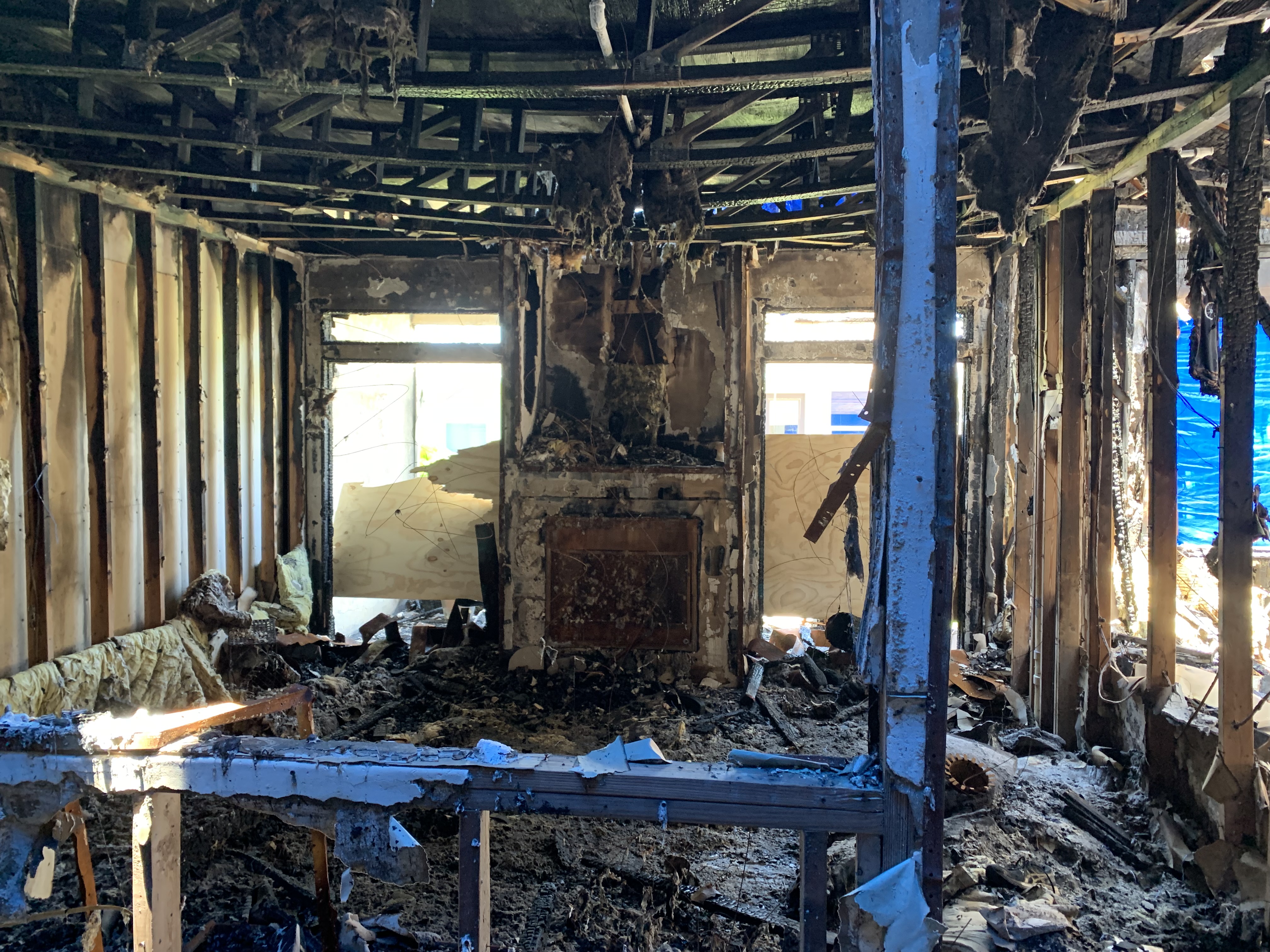
If your house just caught fire, here is what to do: stay out of the structure until the fire department clears it, secure the property against further damage, request the fire incident report, file your insurance claim, and find a place to stay — your policy's Additional Living Expenses coverage typically starts the very first night. This guide walks through the entire process, from the first hours to the day you move back in.
A fire claim is bigger, longer, and more structural than a water claim. Three things matter here that barely come up in a flood: whether your policy pays to bring a rebuilt structure up to current building code, why an independent structural engineer's report becomes the most important document in the file, and why some of your insurance money arrives quickly while the rest is held by your mortgage company and released in stages. Most people learn these three things too late. We manage rental properties in Columbus and we've walked owners through this process, so we wrote the guide we wish everyone had on night one. This is the second piece in our insurance-claim series — the companion guide on flood and water damage claims is here.
The First Hours: Safety, Protection, the Report, and Filing
The first rule after a house fire is simple: do not go back inside until the fire department tells you the structure is safe. Fire compromises framing, floors, and roofs in ways you cannot see, and hot spots can reignite hours later. Wait for the all-clear.
If your family is displaced tonight with nowhere to go, the American Red Cross provides emergency assistance to families after home fires — immediate lodging, food, and essentials. Local responders can often connect you on scene.
Once the scene is released to you, your policy requires you to take reasonable steps to protect the property from further damage. That means emergency board-up of broken windows and doors and tarping over roof openings. Authorizing this emergency work is normal, expected, and typically reimbursable — keep every receipt and photograph the work. What you should not do is sign anything beyond that emergency scope. No assignment of benefits, no direction-to-pay, no open-ended restoration contract — not until your insurer has authorized the work. We cover why in detail below.
Request the fire incident report. In Columbus, Georgia, you request it from Columbus Fire & EMS through their online open records request form. Your insurer will almost certainly want this report, and if the fire marshal investigates the cause and origin, those findings become part of your claim file. Cooperate fully with any investigation — it protects you.
Then file the claim, by app, website, or phone, the same day if you can. Get a claim number and the assigned adjuster's contact information. And the moment you hang up, pull out your actual policy — because what happens next depends on what is in it.
Where You'll Live, and How Long
Additional Living Expenses coverage usually begins the night of the fire, so keep every receipt starting immediately — hotel, meals above your normal grocery spending, laundry, pet boarding, mileage. ALE (Coverage D, sometimes called Loss of Use) pays the extra cost of living somewhere else while your home is uninhabitable. It is typically capped at around 20 to 30 percent of your dwelling coverage, and many policies also cap it in time, commonly 12 to 24 months. If you own the property as a rental, the parallel coverage is Fair Rental Value or Loss of Rents, which replaces the rent you lose while the home cannot be occupied.
Here is the part nobody tells you on night one: significant fire repairs commonly take six to twelve months, and a full rebuild can run longer. Engineering, permits, code review, material lead times, and inspection schedules all stack up. A hotel works for a week. It does not work for eight months with kids in school. Furnished monthly rentals exist for exactly this situation, and insurers routinely pay ALE toward them — if a fire has displaced you in the Columbus area, our short-term rental inventory is built for extended, flexible stays.
Before the Adjuster Arrives: Understand What Your Policy Actually Covers
Your policy pays through four separate coverages, and they pay separately. Coverage A is the dwelling itself. Coverage B is other structures — detached garage, fence, shed. Coverage C is contents, your personal property. Coverage D is the Additional Living Expenses described above. On a financed home, the dwelling money routes through your mortgage company's loss-draft department and is released in stages; contents and ALE checks typically come directly to you. That is why some money arrives fast while the rest seems stuck — it is not stuck, it is being escrowed, and we explain the full loss-draft process in our flood claim guide.
Replacement cost versus actual cash value. Check your declarations page for whether contents and dwelling are covered at Replacement Cost Value (RCV) or Actual Cash Value (ACV). ACV pays the depreciated value — a smaller check. RCV pays the full cost to replace, usually in two disbursements: the ACV amount up front, and the recoverable depreciation released after you document the repairs or replacement purchases. The worked example in the flood guide applies here identically. Know which one you have before the adjuster's inspection, not after.
Ordinance or Law coverage — the clause that decides whether you can afford to rebuild. This is the single most important thing in this guide. When you rebuild after a fire, the City of Columbus will require the new work to meet current building code — today's electrical, plumbing, energy, and structural standards, not the standards of the year your house was built. On an older home, those upgrades can add tens of thousands of dollars. A standard policy covers the cost of putting back what you had; it does not automatically cover the cost of code-required upgrades. That is what Ordinance or Law coverage is for. It typically appears as a percentage of your dwelling coverage — often 10 percent by default, with endorsements available at 25 percent or more — and it also covers costs like demolishing undamaged portions of the structure when code requires it. Look for "Ordinance or Law" on your declarations page. If your home is more than a couple of decades old and you do not have this coverage, the gap is real. If you are reading this before a fire ever happens: call your agent this week.
Contents inventory. Fire claims require a room-by-room inventory of what was destroyed, usually with a deadline. Build it methodically: item, approximate age, replacement cost, and any proof you have. Your phone is your best evidence — scroll your camera roll and cloud backups for old photos and videos that happen to show your rooms and belongings. Order confirmations in your email work too. Do not rush it and do not lowball it.
Smoke and soot. Rooms the fire never touched can still be a covered loss. Smoke penetrates HVAC systems, ductwork, insulation, and porous materials throughout the house, and soot residue is corrosive. This is one of the most commonly under-claimed parts of a fire loss — make sure the adjuster's scope addresses the whole structure, not just the burn area. Water and chemical damage from firefighting itself is also part of the covered fire loss.
Debris removal. Clearing the burned material is typically covered, subject to a sub-limit; many policies make an additional 5 percent of dwelling coverage available when removal costs exceed it. Ask the adjuster to confirm your limit before the haul-off is scoped.
The Structural Engineer: The Most Important Document in a Fire Claim
Hire your own independent licensed structural engineer before repair scope is settled. Their stamped report establishes, in professional terms, what is structurally sound and what must be replaced — which is the entire economic question of a fire claim. Fire can weaken framing, trusses, and connections that look intact, and it can spare things that look ruined. The report defines the honest scope.
That stamped report carries substantial weight in both directions. Adjusters often defer to a licensed engineer's findings on structural questions, and the city's building officials routinely rely on engineer letters when approving repair-versus-rebuild scope and permits. To be precise about the roles: the insurer decides what the policy pays, and the city's building official decides permits and occupancy. The engineer's report doesn't overrule either one — it is independent professional evidence that strengthens your position with both. Your insurer may send its own engineer; that is normal, and it is exactly why having your own independent report matters. Two stamped opinions get reconciled. One stamped opinion — theirs — just gets adopted.
On fees: hiring your own engineer typically costs several hundred to a few thousand dollars, and policies do not automatically reimburse it as a claim expense. There are two honest paths to getting it covered. First, ask the insurer in writing whether it will cover the assessment — if the adjuster agrees it is necessary to determine the scope of loss, it is often absorbed into the claim. Second, engineering work that is required to design and permit the repairs is part of the cost of repair itself and belongs in the contractor's scope. Either way, against a six-figure structural question, it is the best money in the entire process.
If the insurer's position conflicts with your engineer's report, escalate in order: invoke the policy's appraisal clause, consider a licensed public adjuster, and contact the Georgia Office of Commissioner of Insurance and Safety Fire — the state's consumer division exists for exactly this.
Fire Restoration Companies: What They Do, What They Don't, and What Not to Sign
Fire restoration companies secure, clean, and pack out — they are not your rebuild contractor. Their legitimate work matters: emergency board-up and tarping, smoke and soot remediation, deodorization, drying out firefighting water, and packing out salvageable contents for off-site cleaning and storage. Authorizing that emergency protective work is normal and usually reimbursable.
The line you must not cross is signing away your claim. Do not sign an assignment of benefits (AOB), a direction-to-pay, or an open-ended contract "for all necessary services" before your insurer has authorized the scope. This matters in Georgia specifically: once a loss has occurred, an assignment of your policy benefits is legally enforceable here even without your insurer's consent. Sign one in a parking lot at midnight and a company you met an hour ago now controls part of your claim — it can bill the insurer directly, dispute the settlement, and in some cases pursue the claim in your name, and unwinding it is difficult. The restoration company standing in your yard the night of the fire may do excellent work. The paperwork can still wait until your adjuster has authorized the scope. Emergency protection first, signatures later, receipts always.
Getting Quotes and Getting Paid
Get two to three contractor quotes based on the engineer's repair scope and current building code — not on a walkthrough guess. Quotes built on the stamped scope are comparable to each other and defensible with the adjuster; quotes built on eyeballs are negotiating chips. Make sure each one breaks out code-upgrade costs as separate line items, because that documentation is what unlocks your Ordinance or Law coverage.
Payment then arrives in pieces. Contents and ALE checks typically come straight to you as those parts of the claim are approved. The dwelling settlement on a financed home is made out to you and your mortgage company together, goes to the lender's loss-draft department, and is released in draws as their inspector verifies completed work — the full mechanics, including endorsement and disbursement steps, are in our flood claim guide. If your policy pays replacement cost, remember the settlement comes in two waves: the depreciated amount first, and the recoverable depreciation after completed repairs are documented. Build both facts into your contractor conversations from day one: payment comes on a draw schedule, and the final tranche follows final documentation. A professional restoration contractor has heard this hundreds of times and will structure the contract accordingly. Treat it as a red flag if one demands full payment up front.
Rebuilding and Moving Home
The rebuild runs on permits, inspections, and draws — plan around all three. In Columbus, repair and rebuild permits go through the Columbus Consolidated Government's Inspections and Code department, which inspects the work in stages: rough-in inspections behind the walls, then finals.
Utilities come back on the same rails. After a fire, power and gas are typically disconnected for safety, and reconnection is not just a phone call: Georgia Power requires a wiring release from the local inspection authority before re-energizing a repaired structure, and gas service (Liberty Utilities in Columbus) and water (Columbus Water Works) follow their own inspection and relight procedures. This is one more reason the permit path is not optional — no release, no reconnection.
When the work is done, the city performs its final inspection, and where the scope of work requires it, issues a new Certificate of Occupancy — Inspections and Code's sign-off is what makes the house legally yours to live in again. Finalize payments: the last contractor draw, and your documentation package to the insurer to release any recoverable depreciation. Then do the best part, which needs no instructions at all. Move home.
If You Need a Place to Stay
If a fire has displaced you from your Columbus-area home, we manage a portfolio of furnished short-term rentals built for exactly this: flexible, month-to-month stays, fully equipped, no long-term lease. Fire repairs take time, and a real home makes the wait easier. Browse available properties at https://www.5pre.com/short-term-rentals.
Veteran-owned. We've walked owners through this process. Happy to answer questions even if you never book with us.
Frequently Asked Questions
What should I do first after a house fire?
Stay out of the structure until the fire department declares it safe, then take four steps in order: secure the property against further damage (emergency board-up and tarping, keeping all receipts), request the fire incident report — in Columbus, Georgia, through Columbus Fire & EMS's online open records form — file your insurance claim the same day, and arrange temporary housing, because your policy's Additional Living Expenses coverage typically starts the first night. Do not sign anything with a restoration company beyond emergency protective work until your insurer authorizes the scope.
Does homeowners insurance pay for code upgrades when rebuilding after a fire?
Not automatically. A standard policy pays to restore what you had; bringing the rebuilt structure up to current building code is covered only if your policy includes Ordinance or Law coverage. It typically appears as a percentage of your dwelling coverage — often 10 percent by default, with endorsements available at 25 percent or more — and covers code-mandated upgrades and, in some forms, demolition of undamaged portions when code requires it. On an older home, this can be the difference of tens of thousands of dollars. Check your declarations page for "Ordinance or Law."
Do I need a structural engineer after a house fire?
For any fire with possible structural involvement, yes — hire your own independent licensed structural engineer. Their stamped report establishes what is structurally sound and what must be replaced, and it carries substantial weight with both the insurance adjuster and the city's building officials. It does not legally overrule anyone — the insurer decides what the policy pays and the city decides permits — but it is independent professional evidence, and if the insurer sends its own engineer, your report is what keeps the scope honest. If the two conflict, escalation runs through the policy's appraisal clause, a public adjuster, or the Georgia Office of Commissioner of Insurance and Safety Fire.
Should I sign a contract with a fire restoration company before my insurance approves it?
No — authorize emergency protective work only, and sign nothing else until your insurer approves the scope. Emergency board-up, tarping, and securing the structure are normal, usually required by your policy, and typically reimbursable with receipts. But do not sign an assignment of benefits (AOB), a direction-to-pay, or an open-ended restoration contract first. In Georgia, a post-loss assignment of benefits is legally enforceable even without your insurer's consent, meaning a contract signed the night of the fire can hand a company you just met control over part of your claim.
How long does a fire insurance claim take, and how long will I be out of my house?
Plan in months, not weeks. Straightforward claims with limited damage may settle in a few months, but significant fire repairs commonly take six to twelve months from fire to move-in, and full rebuilds can run longer — engineering, permits, code compliance, material lead times, and staged inspections all add time. Your Additional Living Expenses coverage bridges the gap, but it is typically capped in both dollars and time (often 12 to 24 months), so keep the repair timeline and your ALE limits in view together from the start.
What does Additional Living Expenses (ALE) coverage pay for after a fire?
ALE — Coverage D, sometimes called Loss of Use — pays the extra costs of living elsewhere while your home is uninhabitable: temporary housing, meals above your normal grocery spending, laundry, pet boarding, and added commuting mileage. It typically starts the night of the fire, so keep every receipt from day one. Limits usually run around 20 to 30 percent of your dwelling coverage, often with a time cap of 12 to 24 months. For rental properties, the parallel coverage is Fair Rental Value or Loss of Rents, which replaces lost rental income during repairs.
Why does my mortgage company hold part of my fire insurance check?
Because the lender has a legal interest in the property, the dwelling portion of your settlement is made out to both you and your mortgage company, and it goes to the lender's loss-draft department, which releases the money in draws as its inspectors verify completed repair work. This is normal, not a delay tactic — the same process applies in any major property claim. Contents and Additional Living Expenses checks, by contrast, typically come directly to you. Our flood claim guide at https://www.5pre.com/blog/flood-insurance-claim-process-what-to-do walks through the loss-draft process step by step.
Is smoke damage covered by homeowners insurance?
Yes — smoke and soot damage is part of a covered fire loss, including in rooms the fire never reached. Smoke penetrates HVAC systems, ductwork, insulation, and porous materials throughout the house, and soot residue is corrosive over time. Damage from the water and chemicals used to fight the fire is covered as part of the fire claim as well. Smoke is one of the most under-claimed parts of a fire loss, so make sure the adjuster's scope covers the entire structure, not just the burn area.
Sources: United Policyholders — Building Code / Ordinance or Law Coverage · Property Insurance Coverage Law Blog — Assignment of Benefits: Georgia · Columbus Fire & EMS — Open Records Request · Columbus Consolidated Government — Inspections and Code · Georgia Power — Wiring Approval · Liberty Utilities — Columbus, GA Natural Gas · Georgia Office of Commissioner of Insurance and Safety Fire · California Department of Insurance — Debris Removal Fact Sheet · Insurance.com — Additional Living Expenses Guide · Washington OIC — ALE Coverage · American Red Cross — Get Help
